Biweekly vs Semimonthly: Which Pay Schedule Fits Your Budget?
| by MindMath.Net
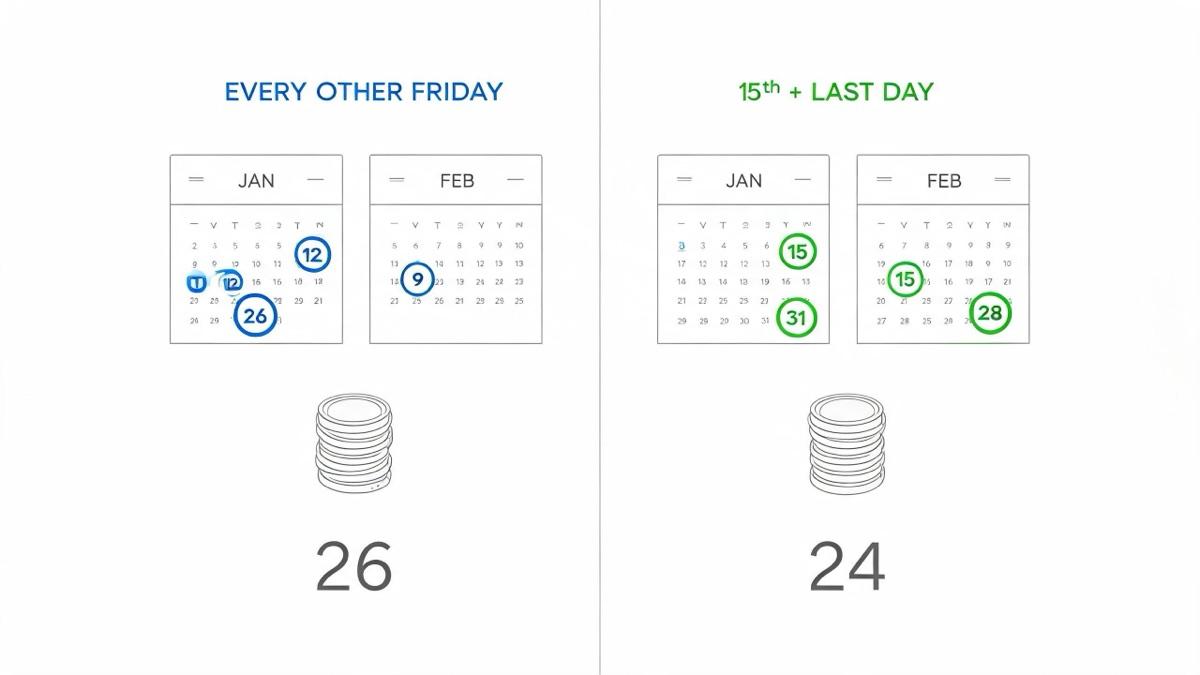
Biweekly vs semimonthly pay comes down to two things: frequency and dates. Biweekly pay means one paycheck every 14 days — 26 paychecks a year, always on the same weekday (usually every other Friday). Semimonthly pay means two paychecks a month on fixed calendar dates, such as the 15th and the last day of the month — 24 paychecks a year. For the same annual salary, your total yearly pay is identical under both schedules. What changes is the size of each check, the shape of your monthly cash flow, and the budgeting method that works best.
Under a biweekly schedule, you are paid once every two weeks. A year has 52 weeks, so the math works out to exactly 26 paychecks, and your payday lands on the same weekday all year long — if you are paid on Fridays, you are paid on Fridays, period.
Two details matter for budgeting:
Depending on where your employer's payroll cycle starts, an occasional calendar year can even include 27 paychecks — worth confirming with HR before you commit every dollar to a rigid plan.
Semimonthly pay delivers exactly two checks per calendar month, typically on fixed dates such as the 1st and the 15th, or the 15th and the last day of the month. That is 24 paychecks a year, and each check equals your annual salary divided by 24 — noticeably larger than a biweekly check, because it covers a slightly longer stretch of time.
The trade-off is that dates are fixed but weekdays are not. A payday on the 15th falls on a different weekday every month, and when it collides with a weekend or holiday, many employers pay you on the prior business day. The intervals also drift: a pay period can run 13, 14, 15, or 16 days, rather than a metronomic 14.
| Feature | Biweekly | Semimonthly |
|---|---|---|
| Paychecks per year | 26 | 24 |
| Paydays | Every 14 days, same weekday | Fixed dates (e.g., 15th and last day) |
| Checks per month | Usually 2; two months have 3 | Always exactly 2 |
| Per-check pay on a $60,000 salary | $2,307.69 | $2,500.00 |
| Monthly cash flow | Uneven | Even |
| Weekend or holiday paydays | Rare; fixed weekday | Possible; often shifted to prior business day |
| Best fit | Hourly workers, extra-check savers | Salaried workers with fixed monthly bills |
Scored on four criteria — cash flow predictability, alignment with monthly bills, check size, and hourly-work compatibility — neither schedule wins outright. The better choice depends on how you are paid and how your spending is structured.
Take a $60,000 annual salary and apply the basic formula:
Per-check gross pay = Annual salary ÷ pay periods per year

Biweekly:     $60,000 ÷ 26 = $2,307.69 per check
Semimonthly:  $60,000 ÷ 24 = $2,500.00 per check
Annual totals match: 24 × $2,500.00 = $60,000, and 26 × $2,307.69 ≈ $60,000 (the per-check figure is just rounded to the cent). Monthly totals do not match:
Both are gross figures — taxes, insurance, and retirement contributions come out of every check. If you have never traced exactly where your money goes between salary and deposit, Understanding Your Paycheck: Gross vs. Net Pay breaks down each deduction step by step.
Pros
Cons
Pros
Cons
Suppose your fixed monthly obligations — rent, utilities, insurance, minimum debt payments — total $4,400.
Semimonthly approach: assign about $2,200 of bills to each $2,500 check. The remaining $300 per check ($600 per month, $7,200 a year) covers groceries, fuel, and savings. One system, every month, unchanged.
Biweekly, bills-first method: each two-check month brings $4,615.38, which covers the $4,400 with $215.38 to spare. Then treat the two third checks — $2,307.69 each, about $4,615 a year — as planned lump sums for your emergency fund, extra loan principal, or investing.
Percentage method: route a fixed slice of every check as it lands. Ten percent of $2,307.69 across 26 checks and ten percent of $2,500 across 24 checks both equal $6,000 a year — the schedule never changes what you can save, only when it arrives. The percentage calculator handles each per-check split in seconds.
Where you point the windfall checks matters as much as catching them. If debt is the target, know what you are really paying — APR vs. interest rate explains why APR is the fairer yardstick for comparing payoff options. If investing is the target, remember that selling eventually can trigger taxes; how to calculate capital gains tax covers the essentials before you hit the sell button.
Most employees do not choose a schedule — the employer does, usually driven by payroll operations and state law. The federal Fair Labor Standards Act does not mandate a pay frequency; minimum-frequency rules are set at the state level (California, for instance, requires wages to be paid at least twice per month), which you can verify through the U.S. Department of Labor. Withholding should not materially change either way, because federal income tax withholding is computed by converting each pay period's wages into an annual figure (see IRS.gov).
With that context, here is the honest verdict:
Before your next payday, spend five minutes on the arithmetic: divide your salary by 26 or by 24 to see your true per-check pay, account for your net deductions, and map your fixed bills onto the calendar. Whichever schedule you are on, turning a confusing payday calendar into a written plan is the difference between money that happens to you and money you direct.
Neither is universally better. Semimonthly pay is easier to budget against monthly bills because every month delivers identical income, while biweekly pay suits hourly workers and creates two natural three-paycheck months you can steer toward savings. For the same salary, annual pay is identical under both.
Biweekly pay produces 26 checks a year — one every 14 days — while semimonthly pay produces 24, two per month. That is why a biweekly check is smaller: the same salary is divided by 26 instead of 24. On a $60,000 salary, that is $2,307.69 versus $2,500.00 per check.
Because 26 paychecks cannot fit as exactly two per month: 12 months × 2 checks is only 24, so the two extra paydays always fall into two calendar months, giving each of those months three checks. Semimonthly schedules never have three-paycheck months — every month contains exactly two.
No. A $60,000 salary pays $60,000 whether it is split into 26 checks or 24 — the difference is timing, not total. The only wrinkle is that an occasional biweekly year can contain 27 paychecks depending on the payroll cycle's start date, so ask payroll how your employer handles those years before building a plan around the extra money.
Two reliable methods: the bills-first approach, where your fixed monthly bills are covered by two checks each month and the third checks are dedicated to savings or debt; and the percentage method, where a fixed share of every check goes to goals as it lands. Both smooth the uneven months without requiring you to track 26 separate dates.